
The Ultimate Guide to Mongolia Tourism: 2026 Industry Trends, Economic Impact, and 10-Year Growth Analysis

Mongolia’s tourism trajectory from 2016 to 2026 represents one of the most successful national rebranding and infrastructure efforts in Asia. By balancing its ancient nomadic heritage with 21st-century connectivity and sustainable practices, Mongolia has secured its place as a top-tier global destination for authentic adventure.
Mongolia has officially emerged as a premier global travel destination. Transitioning from a niche seasonal interest to a central pillar of national economic diversification, the "land of the eternal blue sky" is currently experiencing an unprecedented tourism boom. Following its recognition as Lonely Planet's "Best Place to Travel" in 2024, the nation has surpassed the milestone of one million international arrivals by mid-2026, generating over $2 billion in projected annual revenue.
Mongolia Tourism Statistics: A Decade of Growth (2016-2026)
The last ten years represent a dramatic shift from stagnation to record-breaking expansion. Between 2012 and 2019, growth was modest, with international arrivals seeing a compound aggregate growth rate (CAGR) of only $3.2\%$. However, the post-pandemic recovery, fueled by the "Years to Visit Mongolia" initiative, has seen arrivals skyrocket from 33,100 in 2021 to over 846,000 by the end of 2025.
Strategic Drivers: The "Go Mongolia" Campaign
The catalyst for this surge is the "Go Mongolia" branding campaign. Launched with support from the World Bank, the campaign successfully rebranded Mongolia as a land of "boundless opportunity" and "youthful dynamism".
Global Reach: Content related to the campaign reached 155 million people worldwide, leveraging partnerships with CNN and the Financial Times.
Influencer Impact: The "Nas Summit" alone generated 40 pieces of content that reached 155 million people online.
Targeted Markets: While Russia and China remain strong, South Korea has emerged as a critical driver, with arrivals from Korea, China, and Russia spiking over 50% since 2025.
Infrastructure Revolution: Accessing the "Untouched"
Accessibility was historically the sector's greatest hurdle. Over the last decade, Mongolia has transformed its "global gateway" through massive infrastructure investment.
Chinggis Khaan International Airport (UBN): Opened in 2021 with Japanese partnership, UBN can handle 3 million passengers annually and features wide-body aircraft capabilities for Boeing 747 and 787 jets.
"Flying Without Borders" Policy: This 2025 initiative has expanded direct routes. New 2026 highlights include the first-ever direct link from North America (Toronto to Ulaanbaatar via Air Transat) and year-round Dreamliner service to Singapore.
National Road Network: Paved roads now connect all 21 provinces to the capital, Ulaanbaatar, facilitating easy travel to the Gobi Desert and Lake Khovsgol.
Four-Season Tourism: Beyond the Summer Peak
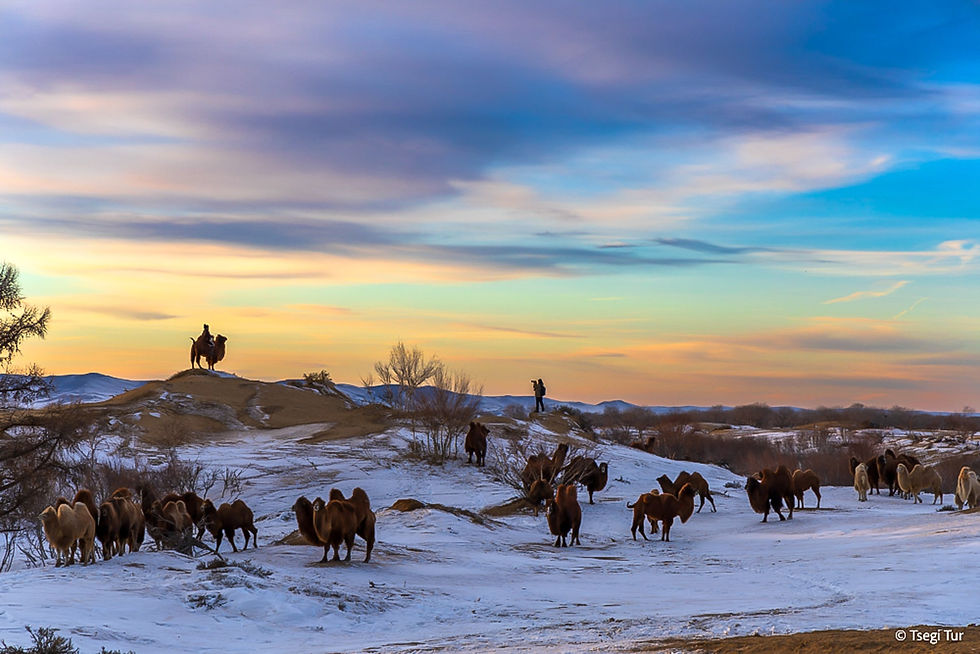
A core component of the "Vision 2050" policy is the transition to year-round travel. Mongolia’s "off-season" is now a high-growth period for adventure seekers.
Winter Festivals: Events like the Ice Festival at Lake Khovsgol and the Lunar New Year (Tsagaan Sar) are attracting thousands of winter visitors.
Adventure Wildlife: Travelers are increasingly booking specialized tours to track snow leopards, ibex, and the Mongolian gazelle in snowy habitats.
Economic Impact: In January 2026 alone, the country welcomed over 21,000 international visitors, signaling that winter is no longer a "slow season".
Sustainable Luxury: The Hospitality Landscape
The accommodation sector has split into two premium segments:
Urban Luxury: Ulaanbaatar hosts international brands including Shangri-La, Kempinski, and Novotel, with upcoming five-star entries like Mövenpick.
Eco-Tourism & Rural Modernization: Rural "ger camps" have modernized rapidly. High-end lodges like Three Camels Lodge and Mongke Tengri Camp now offer private bathrooms and gourmet dining for upwards of $500 per night.
Tech Integration: By 2025, even remote ger camps are utilizing Starlink for connectivity and greenhouses for fresh produce.
Future Outlook: 2 Million Tourists by 2028
The Mongolian government has extended the "Years to Visit Mongolia" program through 2028, setting an ambitious target of 2 million foreign tourists. To achieve this, the Ministry of Culture and Tourism is focusing on:
Digital Integration: Implementation of "Smart Gate" technology and digital arrival cards at airports by mid-2026.
Niche Markets: Rapid expansion in birdwatching tourism (over 500 species) and scientific ecotourism.
Cultural Diplomacy: Fostering the creative industries and "nomadic civilization centers" internationally as part of the Vision 2050 framework.
Mongolia’s tourism trajectory from 2016 to 2026 represents one of the most successful national rebranding and infrastructure efforts in Asia. By balancing its ancient nomadic heritage with 21st-century connectivity and sustainable practices, Mongolia has secured its place as a top-tier global destination for authentic adventure.
#GoMongolia #WelcomeToMongolia#MonGOliaAlwaysMoving#Vision2050#YearsToVisitMongolia


Comments