
Uncovering Deep Time at the Flaming Cliffs

Before the world knew them as dinosaurs, the nomads of the Gobi called them something far more mythical. Long before Roy Chapman Andrews arrived with his cameras and cars, local Mongolians looked upon the massive skeletons emerging from the red earth and believed they had found the "Bones of Dragons" or the remains of legendary "Giant Camels" that once roamed the heavens. For the true adventurer, the Gobi Desert is not merely a summer destinationь it is a year-round epic. To witness the Flaming Cliffs (Bayanzag) in the crisp, silent air of February is to see Mongolia at its most cinematicь a place where ancient myth and modern science collide.
The phenomenon of the Flaming Sands
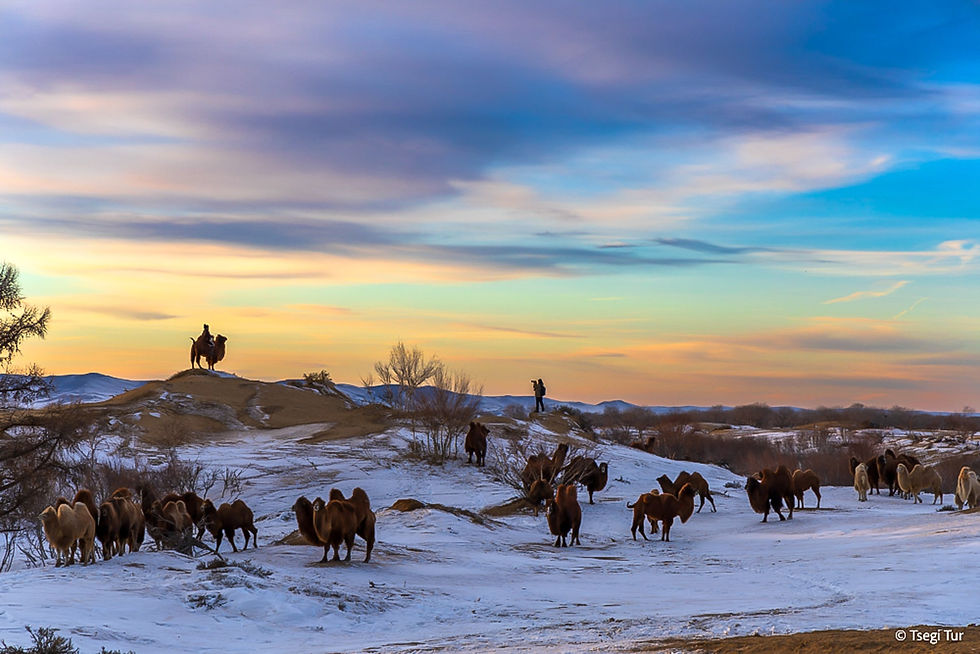
The name "Flaming Cliffs" was coined by Roy Chapman Andrews during his legendary 1922 expedition. Composed of iron-rich red sandstone, the cliffs undergo a breathtaking transformation at sunset. As the low winter sun hits the escarpment, the rock "ignites" into a fiery crimson and brilliant orange, standing in stark, beautiful contrast against the dusted white of the desert snow.
What made this site world famous?
The Flaming Cliffs are the literal birthplace of modern paleontology. In 1923, this site yielded the world’s first discovery of dinosaur eggs, finally proving to the scientific community that dinosaurs were egg-laying reptiles.
The Indiana Jones Connection
Andrews, the real-life inspiration for Indiana Jones—led a fleet of Dodge motor cars across these trackless sands. He was a man of high drama, once surviving a night where his team killed 47 venomous vipers that had crawled into their tents seeking the warmth of the expedition's lamps.
The "Fighting Dinosaurs"
This region yielded one of the most famous fossils in history: a Velociraptor and a Protoceratops locked in a deadly embrace, buried instantly by a collapsing sand dune 75 million years ago. The local name, Bayanzag, translates to "Rich in Saxaul." These are not ordinary trees, they are gnarled survivors that have existed since the time of the dinosaurs. Saxaul wood is so dense and heavy that it does not float, it sinks like a stone in water. Its bark is uniquely spongy and can be squeezed to provide life-saving water for a stranded traveler. Walking through the Saxaul "forest" in winter feels like walking through a gallery of frozen, ancient sculptures. So, this sexual tree is important in the Gobi and the people.
While the world associates the Gobi with summer heat, February is when the "bones of the earth" are most visible. At Jamogrand, we use this "quiet season" as our vital scouting window. The fierce winter winds act as a natural brush, stripping away topsoil to reveal new fossils that have been hidden for millennia.


Comments