
The Deep History Written in the Rocks of Terelj
- Apr 3
- 3 min read

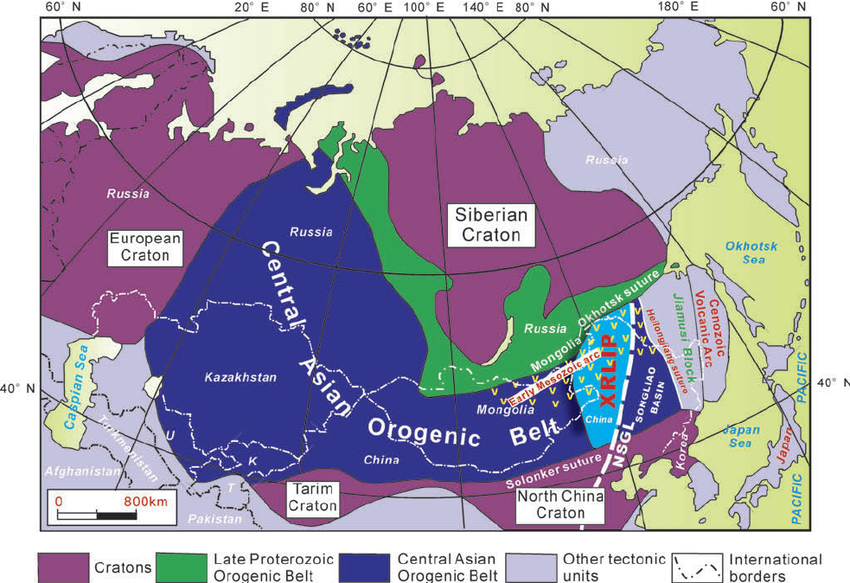
It sounds impossible today, but the Terelj region was once the floor of a massive seaway known as the Mongol-Okhotsk Ocean.
Figure 1: Simplified tectonic map of Asia. Adapted from Şengör et al. (1993) and Xiao et al. (2010). This map illustrates the Mongol-Okhotsk suture and the geological foundations of the Terelj region.
When you leave the bustling streets of Ulaanbaatar, the journey begins across a gentle, rolling sea of green and gold, the classic Mongolian steppe. But as you approach Gorkhi-Terelj National Park, the horizon shifts dramatically. Suddenly, the earth rises in jagged granite spires and massive, rounded boulders that look as if they were dropped by giants.
Why does the landscape change so abruptly? How were these "sculpted" mountains created, and how do ancient trees manage to cling to the very tops of these rocky cliffs? To understand Terelj, we must travel back millions of years to a time when Mongolia was not a steppe, but a vast, churning ocean.
The Lost Ocean of Mongolia
It sounds impossible today, but the Terelj region was once the floor of a massive seaway known as the Mongol-Okhotsk Ocean.
The Ancient Sea: Between 400 and 150 million years ago, this ocean acted as a giant barrier, separating the Siberian craton to the north from the continental blocks of Central Asia and North China to the south. The "Scissor" Closure: This ocean didn't simply evaporate. Instead, the Earth’s massive tectonic plates began a slow-motion collision. Like a pair of closing scissors, the ocean was squeezed out from west to east.
A Continental Collage: Scientists describe this area as a "collage" of continental blocks. As these blocks crashed together along what geologists call the Mongol-Okhotsk Suture, the seabed was buckled and pushed miles into the sky, forming the Khentii mountain range. The remaining water was forced eastward, eventually forming the modern Sea of Okhotsk near Japan.
The Gorkhi Granite
The iconic rocks you see from your balcony at Terelj Hills Lodge weren't formed on the surface; they were forged in the fiery heart of a continental collision.
As the oceanic plates were pushed (subducted) beneath the continents, the friction and intense pressure melted the crust into magma. This molten rock rose toward the surface but remained trapped miles underground.
Because it was buried, it cooled incredibly slowly over millions of years. This "slow-cook" process allowed minerals like quartz, feldspar, and mica to grow into the large, sparkling crystals that give our granite its famous texture. These massive underground domes of rock are known as Batholiths—the hidden foundations of the mountains.
The Science of the "Turtle"
If these rocks formed miles underground, how did they become the "Turtle Rock" or the "Old Man" we see today?

Over eons, the softer surface soil was washed away by rain and wind, revealing the granite "bones" of the earth. Once exposed to the harsh Mongolian climate, two fascinating processes took over. As the weight of the earth above was removed, the granite expanded and cracked in a grid-like pattern. Like an onion, the outer layers began to "peel" away, smoothing the sharp edges into rounds. Wind and ice (frost wedging) worked into these cracks, eroding the fractured sections faster than the solid cores. This differential erosion is the master sculptor that carved the lifelike shapes that make Terelj world-famous.
Travellers often asks that why Trees Grow on Peaks
One of the most striking sights in Terelj is the Siberian Larch and Pine trees growing directly out of the vertical granite faces. This is a testament to the resilience of the Mongolian Taiga. The cracks in the granite (joints) act as natural funnels that collect rare rainwater and wind-blown soil. Once a seed finds a foothold, its roots exert a powerful force, expanding the cracks to find moisture deep within the stone. These trees provide a "green shield" on the cooler northern slopes, creating a stunning contrast between the silver-grey stone and the deep emerald needles.
When you stay at Terelj Hills Lodge, you aren't just a spectator of beautiful scenery—you are standing on the ruins of an ancient ocean and the heart of an extinct magmatic arc.


Comments